Quality control that doesn’t just see, but understands.
AI-based visual inspection for complex defects where standard solutions fail. From the camera to the connection to your control system, all from a single source.
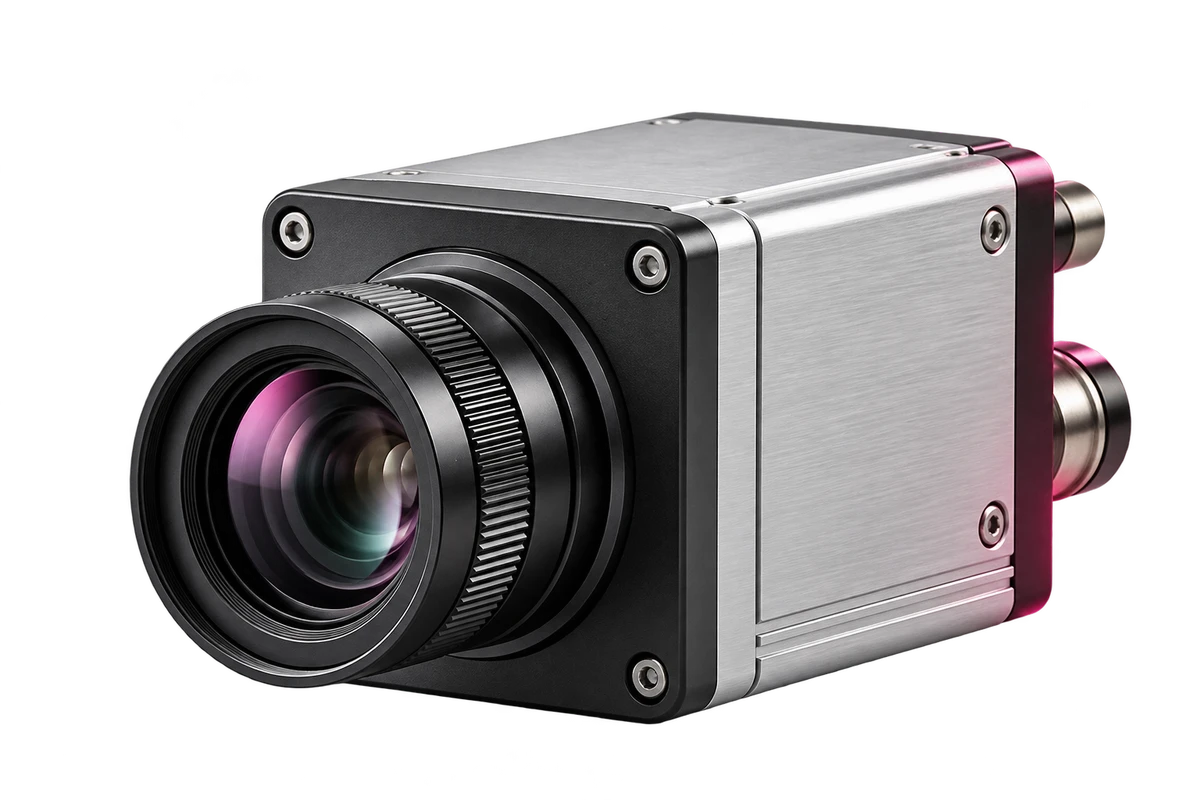
Scrolling moves through the camera lens to a close-up of a gear. A pink detection box labelled Riss marks the crack. The camera pulls back to the inspection result on a monitor in front of the production line. Gears travel on one continuous conveyor from the back left to the front right, passing under an inspection camera that hangs from an arm above the belt. The belt moves forward as you scroll down and backward as you scroll up, including while leaving the hero; it stops when scrolling stops. A clipboard with an inspection log, a pencil and a gear lie on the desk.
Why kaitos?
An AI model alone does not inspect a single part. We connect camera setup, AI software and data integration into one system that takes your quality assurance to a new level.
- Camera setup
- AI software
- Data integration
kaitos in numbers
- images are processed by our solutions for our clients every day on average
- hours of repetitive work are saved by our automations every day
- from a client project to a jointly marketed automation solution
Sound familiar?What we hear again and again in conversations.
“At our volumes we pull samples and have them measured externally. We can’t see what runs in between.”
“Our system mistakes natural variation for defects, yet the real ones still slip through. We want fewer complaints, but not at the cost of even more scrap.”
“Only one person can set up our camera software for new variants, and they work for the software vendor.”
“Visual inspection depends on people we can hardly find anymore, and whose attention fades after hours.”
“Whether defects depend on a line, shift or batch only becomes clear once someone digs through Excel.”
“We want to reduce scrap, but why it occurs is mostly guesswork.”
“The defect occurs at the front of the line, the camera sits at the end. By the time we understand what is going wrong, the order is already ruined.”
SEEDetect complex defects in real time.
100 % instead of sampling
Our AI systems inspect the entire product flow instead of individual samples. Defects on small parts in high volumes stand out just as clearly as foreign objects in bulk goods.
Complex defects
Scratches and dents on reflective surfaces, defects on natural materials: our AI systems reliably tell real defects apart from natural variation. Less scrap, fewer complaints.
Product variety
Product variants, labels or packaging: our AI systems learn new variants from a few example images, without waiting for the specialist at the software vendor.
Consistent inspection quality
Our AI systems inspect with the same care in every shift, even after hours. Your skilled staff take care of the cases that really need their judgement.
UNDERSTANDReact in time instead of living with the consequences.
Classify defects
Our AI systems report not just good or bad, but which defect is present, with image and time stamp. That is the basis for every further analysis.
Spot patterns
Do defects pile up in a shift, batch, line or with one supplier? Your dashboard shows connections that get lost in single inspections, without any Excel.
Prove causes
Our AI systems link inspection results with machine, material and process data. You know whether it is the machine, the raw material or a setting, instead of guessing.
Intervene early
Inspection happens directly after the critical process step. If a process drifts or a tool starts to wear, our AI systems report the trend before the order is ruined.
We build the whole system. In five clear steps.
From the first consultation to ongoing operation, we take care of everything an AI inspection on your line needs. You bring your inspection know-how, we do the rest.
We are only done when it runs on your line.
Book an initial callFree consultation and site visit
In a 30-minute online call, you describe your defect pattern and we show you where current AI helps in your quality control and where it does not. If the use case fits, we look at your line, defect pattern and installation space on site, free of charge.
Concept and feasibility
Together with you, we work out a concept for hardware and software and check feasibility on your sample parts or existing images. This results in a project and budget plan that lets you invest with confidence.
Development: camera, lighting and AI
We design camera, optics and lighting so that your defect reliably shows up in the image, or use your existing cameras. We then capture images on your line and develop your AI system precisely for your products. Your inspectors define what counts as a defect using example images, so their knowledge goes straight into the system.
Integration into your line
We connect the system to your PLC: a good/bad signal at cycle time for automatic rejection, data to your ERP or dashboard. Your automation and IT teams agree the interfaces with us. Your line takes care of diverting parts.
Handover and operation
After handover, your system runs independently and robustly in continuous operation, without ongoing development effort. If products or defect patterns change later, we extend it in a targeted way. If you wish, we train your team to do this themselves.
System solution
at a glance
We combine camera images, sensor and order data with your inspection know-how and feed the result into the systems you already use: on site at the line, in your data centre or in the cloud.

- On site at the line
- On your servers
- Public cloud
When we are the right choice
| Criterion | | Manual inspection | Rule-based standard system | Smart camera with AI function | AI platform |
|---|---|---|---|---|---|
| Difficult conditions for camera and lighting | – | ||||
| High volumes, short cycle times | |||||
| Variable defects, e.g. with natural products | |||||
| High product variety, changing products | |||||
| Varying material, many false alarms | |||||
| Integration into established legacy systems | – |
kaitos compared with
| Criterion | Manual inspection | |
|---|---|---|
| Difficult conditions for camera and lighting | – | |
| High volumes, short cycle times | ||
| Variable defects, e.g. with natural products | ||
| High product variety, changing products | ||
| Varying material, many false alarms | ||
| Integration into established legacy systems | – |
yespartlyno–not applicable
What our clients say
In our joint visual quality-control project, Kaitos demonstrated how seamlessly hardware expertise, AI development and clean software architecture work together. The resulting solution has been running smoothly in production ever since.
 Sebastian BetzinCTO, generic.de software technologies AG
Kaitos gave us excellent technical advice on the opportunities offered by AI and modern NIR camera technology for visual quality inspection and sorting around our plant—we would gladly work with them again.
 Andre HeilemannHead of Research and Development, EMSLAND-STÄRKE GMBH
Working with Kaitos enabled us to identify and implement automation potential in image recognition, sustainably optimising our processes.
 Frank RibbersManaging Director, WiR Solutions GmbH
We are very happy with our collaboration with the Kaitos team. AI-based OCR reduced the error rate in automated prescription processing by one third and significantly lowered our manual review effort.
 Reiner StürmerHead of Technology, ARZ Darmstadt
Kaitos helped us evaluate AI software extensions for visual sorting in our potato lines, quantify their value for quality control and assess the costs reliably—technically precise and refreshingly straightforward.
 Stephan ThorhauerLogistics Project Manager, Solana Group
Together with Kaitos, we developed exciting approaches for timber traceability in our production using camera technology and AI. Innovative, highly competent and very pleasant to work with.
 Michael GlitzTechnical Director, Holz Henkel GmbH & Co. KG
The vehicle registration recognition powered by deep learning achieves recognition rates above 99.5%. With the development of “fahrzeugscheinDigital”, the project became a successful standalone product.
 Thomas AuerManaging Director, KÜS DATA GmbH
In our joint visual quality-control project, Kaitos demonstrated how seamlessly hardware expertise, AI development and clean software architecture work together. The resulting solution has been running smoothly in production ever since.
Sebastian BetzinCTO, generic.de software technologies AGKaitos helped us evaluate AI software extensions for visual sorting in our potato lines, quantify their value for quality control and assess the costs reliably—technically precise and refreshingly straightforward.
Stephan ThorhauerLogistics Project Manager, Solana GroupKaitos gave us excellent technical advice on the opportunities offered by AI and modern NIR camera technology for visual quality inspection and sorting around our plant—we would gladly work with them again.
Andre HeilemannHead of Research and Development, EMSLAND-STÄRKE GMBHTogether with Kaitos, we developed exciting approaches for timber traceability in our production using camera technology and AI. Innovative, highly competent and very pleasant to work with.
Michael GlitzTechnical Director, Holz Henkel GmbH & Co. KGWorking with Kaitos enabled us to identify and implement automation potential in image recognition, sustainably optimising our processes.
Frank RibbersManaging Director, WiR Solutions GmbHThe vehicle registration recognition powered by deep learning achieves recognition rates above 99.5%. With the development of “fahrzeugscheinDigital”, the project became a successful standalone product.
Thomas AuerManaging Director, KÜS DATA GmbHWe are very happy with our collaboration with the Kaitos team. AI-based OCR reduced the error rate in automated prescription processing by one third and significantly lowered our manual review effort.
Reiner StürmerHead of Technology, ARZ DarmstadtFrequently asked questions
The problem usually lies in one of two places: the defect is barely visible in the image (camera, lighting), or the evaluation works with rigid thresholds and reports too many false rejects. Using your existing images, we find out which of the two it is. Often we can keep using your cameras and only replace the evaluation.
If your defect can be described by fixed rules, such as a clear dimensional limit, a standard system is often enough. It is also cheaper. We are the right choice when defects look different every time, the material varies by nature or an existing system produces too many false alarms.
What an experienced inspector can see in the image, the AI can usually learn: scratches, cracks, voids, excess material, chipping, discolouration, missing parts, incorrect marking. With near infrared we can also see foreign objects, moisture or material differences. What cannot be seen from the outside at all, such as strength or internal defects, a camera cannot inspect either.
That depends on the defect, the technology and the integration; you get a first estimate in the initial call. Compare it with what escapes, complaints, rework and staff for visual inspection cost you today. Based on our experience, we can quickly assess whether the ROI works out for you.
The system also recognises the same defect types on new variants. If a new defect type or a very different product is added, we retrain with example images. No new development is needed for this. With very many, constantly changing products, we talk openly about the effort beforehand.
These are exactly the points we check on site before the project starts. We design camera, lighting and computer for your cycle time and environment. In the proof of concept, the system runs under real conditions before you invest in the integration.
Your images and inspection results belong to you and stay with you. If you wish, we set up the system so that your team can adjust defect limits and retrain it themselves.
The system sends the OK/NOK result to your controller at cycle time. Your line takes care of rejecting the part.
As you prefer: on a computer on site at your plant or on a privacy-compliant server in Germany.
We remain your point of contact after go-live: we install updates, retrain for new variants and train your team. Scope and response times are agreed together in a service contract.
In 30 minutes online, you describe your defect. You find out whether and how AI can help, what an approach would look like and roughly what it would cost. Free of charge and without obligation.
Tell us about your defect pattern.
In a free consultation, we tell you whether and how AI can help on your line, and also if it cannot. Beyond that, we are your partner for AI: we help you understand what is state of the art today, what works reliably and where the limits are.
What happens next
- 1Whether you have a concrete use case, open questions about AI or are simply curious: tell us briefly what interests you.
- 2We get back to you promptly and suggest a date.
- 3In a 30-minute call, you receive an honest assessment or ideas on what AI can do in your production.